
Reblocking
Reblocking is the combination of small blocks into larger units for scheduling. The purpose of reblocking is to speed up optimization while not sacrificing accuracy in terms of mining selectivity. Reblocking happens at the time of importing blocks into Minemax Scheduler for the purpose of transforming a block model into a schedule model.
Note that when blocks are combined for reblocking according to any of the methods below, product ratios of combined blocks are calculated based on a total tonnage weighted average of all original block product ratios. Also, attributes within products of combined blocks are calculated based on a tonnage weighted average of the product tonnes of the original blocks.
For example, consider a simple scheduling model with 2 products called Mill and Waste. Mill has a single attribute au and Waste has no attributes.
There are 4 blocks as follows:
| Block | Mass | Mill | au | Waste |
|---|---|---|---|---|
| B1 | 1000 | 1.0 | 3 | 0.0 |
| B2 | 1000 | 1.0 | 2.2 | 0.0 |
| B3 | 1000 | 0.0 | 0 | 1.0 |
| B4 | 1000 | 0.0 | 0 | 1.0 |
B1 and B2 are ore with grades of 3 and 2.2 respectively. B3 and B4 are waste blocks. The combined block would be:
| Block | Mass | Mill | au | Waste |
|---|---|---|---|---|
| BCombined | 4000 | 0.5 | 2.6 | 0.5 |
There are a number ways to reblock in Minemax Scheduler as shown below. Grade-based reblocking is the recommended option for large block models where stockpiles and/or alternative processes are part of the schedule model.
No Reblock
It is possible to import blocks directly without reblocking. However, with block numbers in the order of 1 million or more, this approach can result in models that may take days to solve or may be unsolvable from a computer memory point of view.
Geometry Reblock
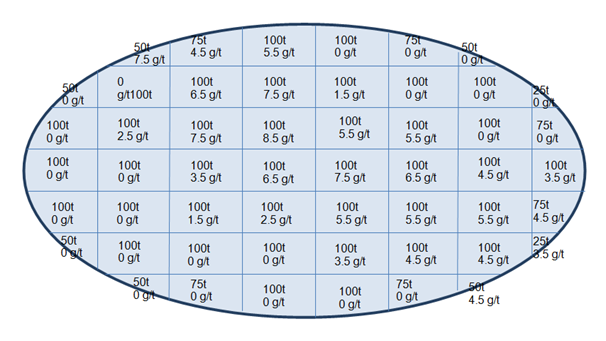
With geometry-based reblocking, adjacent blocks are combined into larger blocks. Typically this happens only within a bench. For example 10x10 blocks can be combined into 50x50 blocks. It is important to understand that when there are stockpiles or alternative processes, scheduling destination decisions will be made based on the combined block. That is, whatever happens to the combined block can be considered to effectively happen to every original block of the combined block.
Original Model
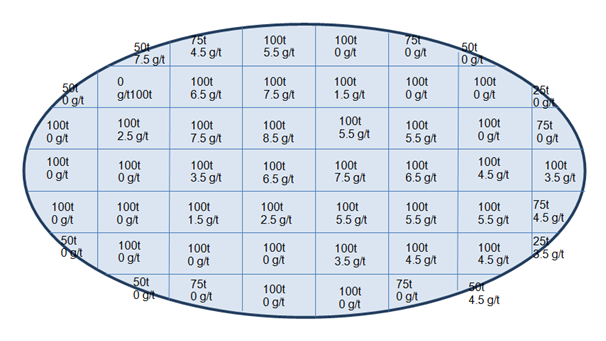
Geometrically Reblocked Model
Grade Reblock
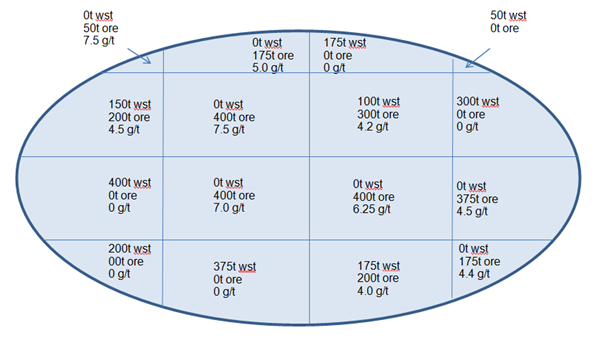
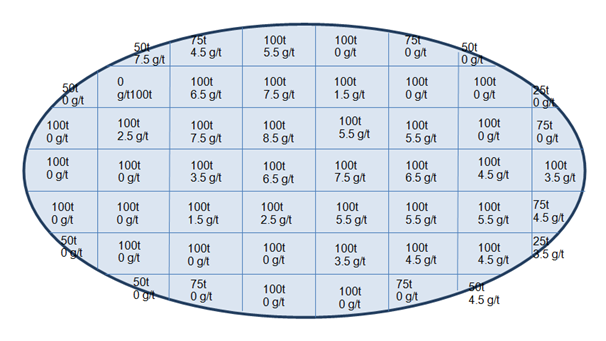
Grade-based reblocking is sometimes referred to as grade binning. With grade-based reblocking, the number of blocks per bench can be reduced from 100 to 10. Surprisingly, this 10x reduction in the number of blocks can give an optimization speed-up of more than 10x.
A key step is determining the number of grade bins and their ranges. With more grade bins comes a greater selectivity across alternative destinations. However this also comes at a price of computation time.
It is always good practice to define at least one grade bin for material that is known to be waste. As for ranges of the other grade bins it can be something of an art to decide grade ranges. One approach is to determine bin ranges that give equal tonnages of ore for non-waste material. Another is to identify cut-off and cut-over critical grade areas and have more total tonnage around these critical areas.
Note that the resulting aggregate blocks do not have any geometry apart from the fact that they exist on the same bench. It is like a reserve calculation at the bench level.
Original Model
Grade-based Reblocked Model
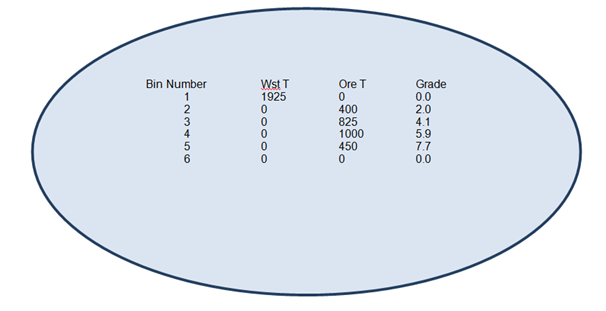
| Bin Number | Minimum Grade | Maximum Grade |
|---|---|---|
| 1 | 0 | 1.0 |
| 2 | 1.0 | 3.0 |
| 3 | 3.0 | 5.0 |
| 4 | 5.0 | 7.0 |
| 5 | 7.0 | 9.0 |
| 6 | 9.0 | 100 |
