
Wireframe Difference
To access this screen:
-
Wireframe ribbon >> Boolean >> Difference.
-
Using the command line, enter "wireframe-difference"
-
Use the quick key combination "wdi".
-
Display the Find Command screen, locate wireframe-difference and click Run.
Use two open or closed wireframe objects (or two selections of wireframe triangle data, or a combination of object and selection) to create another wireframe object which represents the first wireframe data with any volume shared with the second wireframe data removed.
You can optionally set a Key field for Wireframe 1 and Wireframe 2. Use <None> when you do not want key-based grouping on an input. When a key field is set, each key value is treated as a separate wireframe group during difference calculation.
If key fields are set for both inputs, processing is performed for each value-by-value combination across the two wireframes.
Note: this command is also available using the BOOLEAN process (@METHOD=2)
Note: selection order is important for this command. The result of (Wireframe 1 - Wireframe 2) may be different from (Wireframe 2 - Wireframe 1).
Note: This command supports flexible wireframe selection.
Command Example
|
Original Wireframe Objects |
||
|
Object 1 |
Object 2 |
Output |
|
|
|
|
|
|
|
|
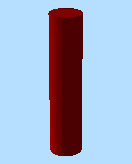

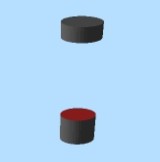
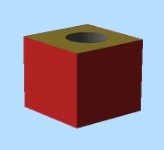
Command steps:
-
Load both wireframe objects that are considered during the Boolean calculation.
-
Choose the data to represent Wireframe 1. This can either be an entire Object, or the Selected triangles of one or multiple wireframe objects.
Optionally choose a Key field for Wireframe 1, or choose <None>.
Note: if using selected triangles, click Store current selection to identify the data to be used in calculations. If you change your selection, remember to reselect this button to ensure the input data is updated.
-
Do the same for Wireframe 2.
Optionally choose a Key field for Wireframe 2, or choose <None>.
Note: you don't have to follow the same data selection method as Wireframe 1 (for example, Wireframe 1 could be a full object and Wireframe 2 could be selected triangles).
-
Choose the Output Wireframe mode.
-
Single Object: output is written to one object.
-
Multiple New Objects: output is split into multiple objects according to key field grouping.
-
If both input key fields are <None>, only one output object is created.
-
If one input key field is set, one output object is created for each key value group in that input.
-
If both input key fields are set, one output object is created for each value-by-value combination.
When multiple output objects are created, names use the configured Prefix plus an incremental numeric suffix (for example, Difference: 1, Difference: 2).
If only one new output object is created, the New field text is used as the object name.
If output is directed to an existing object, the existing object name is preserved.
-
-
Click OK.
Related topics and activities
