
Boundary Analysis
Studio RM supports estimation using multiple methods to determine sample influence when estimating grades into cells.
Advanced Estimation supports several boundary options that control how samples from neighbouring geological domains influence the estimation of block model grades.
The appropriate boundary treatment is typically determined through boundary analysis. Boundary analysis examines samples located close to a domain contact to evaluate whether grades change abruptly or transition gradually across the boundary. This is usually done by analysing samples within a specified distance of the domain surface and comparing grade distributions and continuity on either side of the contact.
The results of boundary analysis help determine whether the boundary should be treated as hard, soft, or semi-soft. Advanced Estimation also offers Custom Zones, which allow combined multiple samples, to inform an estimation zone.
Note: Custom Zones and Soft Boundary Estimation are mutually exclusive options.
-
Studio RM does not currently include a dedicated boundary analysis tool. This analysis is commonly performed using geostatistical software such as Datamine Supervisor or Isatis.neo, with the results then informing the boundary settings used in estimation.
A hard boundary assumes a sharp transition of grades across the geological contact. Samples from neighbouring domains are not used during estimation. In this case there is a one-to-one relationship between the domain of the block being estimated and the domain of the samples used for the estimate. For example, samples in zone N are only used to estimate blocks in zone N. Hard boundaries are the default behaviour when zonal control is applied.
A soft boundary assumes grades are continuous across the contact and allows samples from neighbouring domains to influence the estimate. In Studio RM, this behaviour can be achieved by combining domains into custom zones, allowing samples from multiple zones to be used during estimation. This gives you control of which adjacent domains influence an estimate.
A semi-soft boundary provides an intermediate approach. Samples from neighbouring domains may influence the estimate, but only if they lie within a defined distance of the domain boundary. This distance is specified using a tolerance parameter. Semi-soft boundaries allow limited cross-boundary influence consistent with the distances observed during boundary analysis, while still allowing a larger search distance for selecting samples within the domain.
If the tolerance distance in semi-soft boundary is set large enough (to equal or greater than the longest range of the search parameters), it becomes a soft boundary.
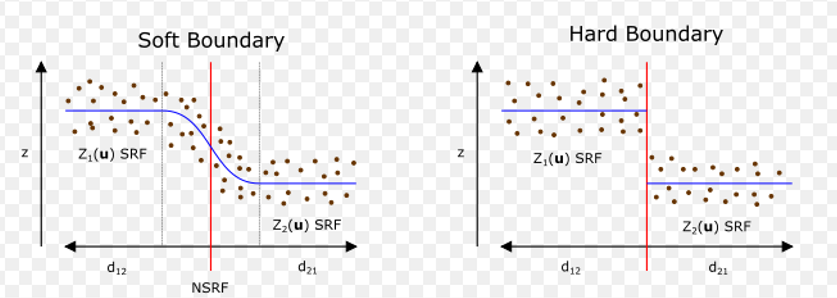
Soft and hard boundary estimation principle (click to expand)
Hard, Soft and Semi-Soft Boundary Estimation
In many estimation studies there will be a 1:1 match between the zone in which the model cell is located and the zone in which the samples are located. In this scenario, only samples in zone N are used to estimate model cells in zone N. These zone boundaries are defined as Hard boundaries.
If the geostatistical characteristics of two or more zones are similar it may be beneficial for estimation to include samples from other zones. This is particularly useful if some zones have few samples. Defining soft boundaries allows zones to be defined according to input sample attribute values, and the estimation to use samples from more than one zone. For example, samples in zones 2, 4 and 6 are used for estimating model cells in zone 2; samples in zones 4 and 6 for cells in zone 4, and samples in zones 2 and 6 for cells in zone 6. In this situation the zone boundaries are defined as Soft boundaries.
Another option is to use soft boundaries, but constrain the extent to which neighbouring zone samples are considered for estimation by the specification of one or two wireframe volumes within a tolerance distance. These act as limiting boundaries, ensuring only samples within the wireframe shape (or shapes) contribute to cell estimation. This constricted form of soft boundary estimation is known as semi-soft boundaries. In this scenario, samples outside a domain can still influence estimates inside the domain, but influence is limited to a defined distance from the boundary, where the distance is defined as a tolerance using the Define Search Volumes screen. The semi-soft approach can result in a more controlled transition between domains.
Important: Input wireframes for semi-soft boundary estimation require a domain field, and the domain code must match the block model.
Note: If you are using two wireframes for two zones, they must not overlap.
Optionally, soft boundaries can be modelled by defining Custom zones of two or more sample zones. Each custom zone is then assigned to a model zone when the estimations are defined using the Define Estimations screen.
Alternatively, you can use the hard boundaries approach by not defining custom zones.
Related topics and activities:
