
 Studio UG
Studio UG is the complete solution for underground design and scheduling. It meets all your underground design and data management needs.
Datamine’s industry-leading systems form an unparalleled, integrated toolset for underground mine planning. Whether for an active mine production environment or a potential mine, from concept through to bankable feasibility stage, Datamine’s solution will help you design, plan and schedule all aspects of your underground mine.
Who uses Datamine Studio UG?
Underground production planners and engineers.
Studio UG Benefits
Accessible, Simple & Practical
Most underground planning software packages require extensive customization for each situation or application. This can be daunting and commonly this challenge is only resolved with lengthy and costly up-front configuration, implementation and training projects.
Studio UG has been designed to break this mould and remove the training burden by providing a standard system with intuitive and understandable controls, thoughtfully designed for underground mine planning requirements.
Big Data?
Studio UG’s 3D engine can easily handle large data sets. As a 64-bit application, you can manipulate your 3D data view without having to worry about the typical screen ‘judder’ and unbearable lag associated with other products.
Unlimited Views
Not only does Studio UG provide a robust and powerful 3D engine, it also allows you to view your data using multiple windows, all connected to the same underlying data source.
Split your windows vertically and/or horizontally or spawn floating, interactive 3D windows that can be either linked to a parent view or entirely independent. You can even split external views, which can be clipped independently and positioned outside of the application frame.
Full 3D Models - Not Just Slices!
Datamine understands that to truly understand how to design your developments, you must work in relation to your estimated resources. If you can’t ‘see’ your planning model in full 3D space, you run the risk of uninformed or risky decisions.
Studio UG incorporates the planning model into all aspects of its workflow, allowing it to be rendered with a huge range of visual formatting options, including 3D blocks. A full and interactive 3D block representation is the only way to do proper design and consider all the information relevant to the process.
Integral Database (Design to Plan)
A key principle that underpins Studio UG is the database that holds project data, from the original design strings to the schedule-in-use.
Studio UG maintains original design files securely within its project so you can review source data at any time, reinforcing your governance and reducing the unnecessary rework associated with orphaned design data.
Smart Stope Optimization
Studio UG includes the latest available version of Datamine’s Mineable Shape Optimizer (MSO).
Studio UG presents MSO with an intuitive interface to guide you through the process without the need for extensive training. You can also setup sensitivity runs automatically – there’s no need to create each one manually.
Connected, Differential Sequencing
There’s little point in completing a logic sequence and then exporting to your scheduler to see the impact of rates and times on the schedule. With some software, this inevitable two-step process is time-consuming and costly.
Studio UG smashes this challenge with a clever connection to the scheduling engine so rates are considered whilst you create the links. By the time you export to Datamine’s Datamine Task Scheduler (DTS), the work is basically done, saving considerable time, effort and unnecessary rework.
Multiple Objects per Design Type
Having only a single object or layer for each design type is okay for simple projects but becomes highly restrictive for more realistic scenarios. Merging design files in advance to process activities for scheduling is a costly workaround and reduces the granularity of your project.
With Studio UG, you aren’t restricted to a single design object for each type – use whatever you need! This multi-object approach lets you complete your design in manageable chunks by a team of engineers, all linking through to data preparation seamlessly.
One-click Change Processing
Studio UG challenges the concept of having to process each design type using a separate interface. In Studio UG, it’s all done in one place, creating all activities and solids for you automatically.
…and it’s processing of changes, not a rerun of all processing. This significantly reduces the time take to process alterations and makes it possible to test out different configurations and witness the impact on the schedule in a practical timeframe.
Processing feedback is clear and interactive; review and refine your configuration quickly and easily, then just re-process the changes in a single click!
Animations in Seconds!
Studio UG animations are generated automatically, using the current time scale set in . So much simpler than competitor systems that require a manually defined animation legend!
Multiple Model Support
Studio UG will not restrict you to a single-model project. There is no need to combine your models or work out how to join models with different rotations in advance.
In Studio UG, you can add multiple block models to your project; if your design spans multiple models you can have multiple files and run interrogations on different mine areas by applying a filter in the interrogation settings. This is much more convenient and allows you to have smaller individual block models loaded.
When running evaluations it is also faster as the models are smaller when loading to memory for that process.
Portable Projects
Studio UG projects are recognized by other Studio applications, including Studio RM, EM and OP.
This provides useful opportunities for inter-departmental collaboration and ensures that your valuable corporate data is protected by a single collaborative framework of products.
It also minimizes the impact of potentially risky data type conversions throughout the life cycle of your data.
Workflow Automation
Save time and reduce errors on sites by capturing and automating pieces of workflow to reliably carry out repetitive and complex tasks. Studio UG offers several approaches to automation with scripts and macros. See Automating Studio Products and Introducing Macros.
MineTrust Data Management
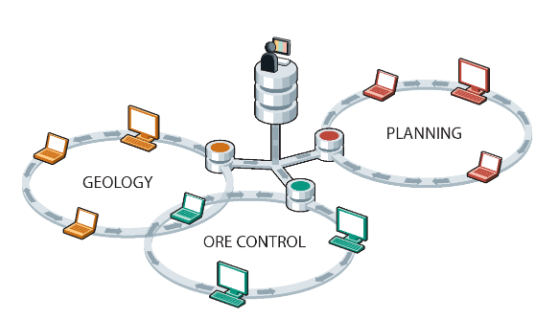
MineTrust is Datamine's data sharing service; a data management solution that is used to share and synchronise versions of files and groups of files between multiple users and teams in separate locations. Unlike many other file synchronisation systems, MineTrust can deal with groups of files, or packages, with a mix of file types that are synchronised and shared together. MineTrust can tag packages and files with any amount of meta data to reflect the data’s content, purpose, and how it is used within organisations and business processes.
Note: If you are interested in supporting your business with MineTrust but haven't made the move yet, contact your local Datamine office to work out a plan that's best for you.
MineTrust is built into Datamine Studio products by default. The use of automatically assigned tags specific to products and workflows, enables data to be shared automatically and efficiently between users and products, removing the need to manually manage and transfer files.
A cloud-hosted, highly secure data storage service, MineTrust provides reliable data management services for all team members, regardless of their location. Data is 'pushed' to the server following changes on the desktop and 'pulled' to other users' machines where newer data is available. This makes the following tasks to be performed very quickly and easily:
-
Sharing the latest 'ground truth' with other team members, such as sharing the latest field mapping data with resource modellers, or the latest EOM survey results, and so on.
-
Sharing reference data amongst multiple team members, such as the latest development plan to update reconciliation results, or a standard legend to be used for corporate-level reporting, for example.
-
Pushing data along a workflow, such as the latest drillhole sample data for implicit modelling revisions.
MineTrust is built specifically for resource modelling and mine planning workflows. Its integration with Studio products ensures teams collaborate in real-time without leaving their familiar working environment. It helps eliminate miscommunication and data duplication by centralising project files and enforcing structured sharing practices across departments, operations and the corporate enterprise.
See MineTrust and MineTrust-Enabled Projects to get started.
Related topics and activities:
