
Localized Uniform Conditioning (LUC)
LUC Overview
The Localized Uniform Conditioning is designed for non linear estimation in mining. It is used as a Uniform Conditioning's post-processing. The assumption is that the tonnage (T) and metal quantity (Q) have been calculated for various cutoff grades on a panel grid (larger blocks). The goal is to generate a “localized” grade variable estimate on a corresponding Selective Mining Unit (SMU) grid, containing smaller blocks. The grade-tonnage curve of the localized variable should match the grade tonnage curve defined by the Q and T macro-variables in each panel.
The local grade metal tonnage calculated by Uniform Conditioning is preserved while the distribution of the grades for each block is guided by the ranking of block (or Selective Mining Unit) estimates.
Note: While the name of this window refers to Uniform Conditioning, the Q and T macro-variables can be calculated using any method, e.g. by Multiple Indicator Kriging.
The LUC results are stored in a SMU (Selective Mining Unit) grid file. The SMU corresponds to the block support read from the input Geostatistical Set. The SMU file can be created by the UC-LUC module. If it already exists, the mesh of the grid must match the block support read from the Geostatistical Set and its geometry must match the Panels File (the corners of the grids must match).
Interface
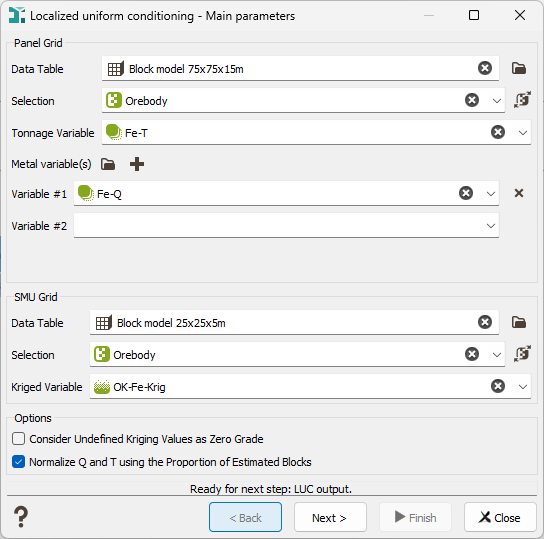
-
Panel Grid
- Data Table: The panel grid, containing the tonnage and metal quantity variables.
- Selection (optional): A selection to restrict the calculation to a part of the panel grid.
- Tonnage Variable: A macro-variable containing the tonnage values (T) at various grade cutoffs. The indices of the macro-variable are the cutoffs, and the tonnage values should be on a scale of 0 to 1 (or 0% to 100%).
- Metal Variable(s): One or more macro-variables containing the metal quantity (Q). These macro-variables must have the same indices as the tonnage macro-variable.
-
SMU Grid
- Data Table: The SMU grid.
- Selection (optional): A selection to restrict the calculation to a part of the SMU grid.
- Kriged Variable: The localization process works by ranking the SMUs in each panel by the value of the Kriged Variable, and re-assigning grades in this order from the grade-tonnage curve for the panel. While it is labelled “Kriged Variable”, any numerical variable may be used for this purpose.
-
Options:
- Consider Undefined Kriging Values as Zero Grade: If this option is checked, then undefined values of the Kriged Variable will be replaced by zeros, and the localized estimate will be calculated on all SMUs in the selection.
- Normalize Q and T using the Proportion of Estimated Blocks: If this option is checked, then the values of the Q and T input variables in each panel are multiplied by the proportion of blocks in the panel where the Kriged Variable is defined (this multiplication happens in the background during the calculation, and the original values of the input macro-variables are not replaced permanently).
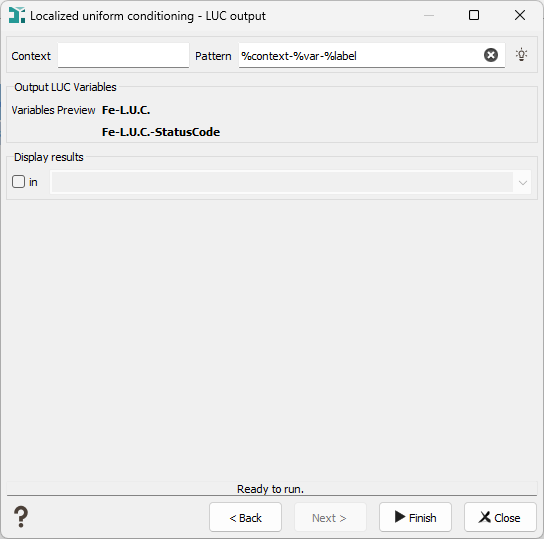
-
Output
-
Pattern: The pattern for the output variable names, by default “%var-%label”. The “%var” keyword will read the metal variable name for the localized variable(s), and the tonnage variable name for the status code. In both cases, it will omit the letter “Q” or “T” if it appears at the end of the input variable name.
- On the SMU grid, there will be one output variable created for each input metal macro-variable.
- On the Panel grid, a Status Code variable will also be created.
-
- Display: If the checkbox is ticked, the results are automatically displayed in the Map or 3D Scene, depending on the user’s choice, at the end of the Run.
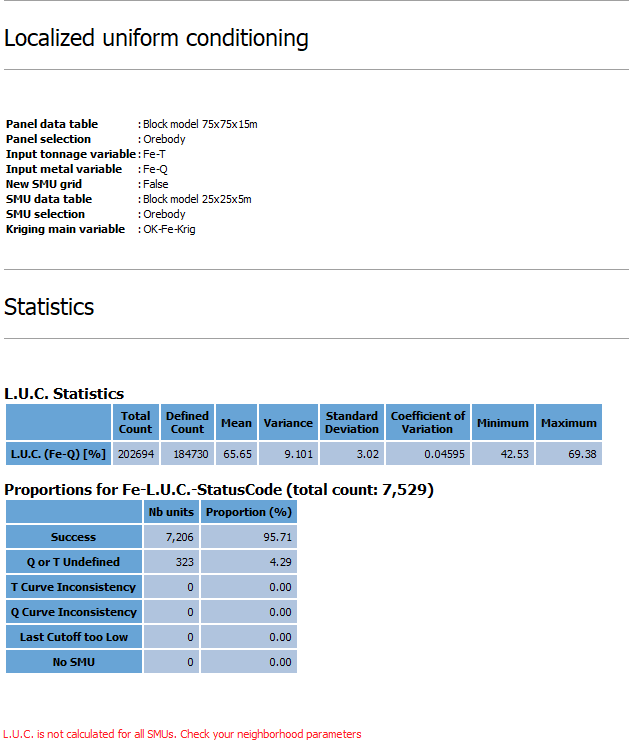
- Run: At the end of the calculation, the statistics of the localized variable(s) are printed to the Messages. If not all blocks were estimated, then the cause of these non-estimates (stored in the Status Code variable in the panel grid) are also printed to Messages.
The Status Code variable is created in the Panel grid. By calculating the variable statistics, the following table is printed in the Messages.
LUC Parameters
LUC requires the definition of a list of cutoffs covering the whole distribution of the grades. When the LUC is requested, Smart Cutoffs may be added to the list of cutoffs defined for UC results. The added cutoffs are:
- 25 quantiles corresponding to 25 percentiles between 0 and 10%,
- 50 quantiles corresponding to 50 percentiles between 10 and 90%,
- 25 quantiles corresponding to 25 percentiles between 90 and 100%.
The variables Q,T and M are computed for all Smart Cutoffs for the LUC post-processing but are not saved in the database.
Optionally, when SMU are not kriged (because there are not enough data in the neighborhood) the LUC result may set to 0. Otherwise, the result is left to N/A.
LUC Errors
A variable containing an LUC error code is also stored in the Panel Grid File (not in the SMU file). This variable is a categorical variable indicating whether the LUC is successful or not. The possible categories are:
- Success: LUC is successful for that panel.
- Q or T Undefined: There are missing values in Q or T. Should never happen.
- T Curve Inconsistency: There are inconsistencies in the T curve, either T > 1 or T increase.
- Q Curve Inconsistency: There are inconsistencies in the T curve, Q increases.
- Last Cutoff too Low: The list of cutoffs did not cover the whole distribution. Usage of Smart Cutoffs is recommended.
- No SMU: There is no defined SMU inside the panel.
