
MSO Economics
In MSO, economics define the economic objectives for your stope shape optimization scenario. For example, are you trying to optimize your shapes to capture the highest possible stope grade or recover the highest possible volume of metal?
-
Grade maximization will mean that the grade or value per tonne will be optimized based on material that is above the specified cut-off grade. This is the recommended selection in most optimization scenarios.
-
Metal recovery optimization will mean the recovered metal or value will be maximized whilst considering material below the cut-off grade.
In more detail: the metal recovery objective is applied to the cut-off or (cut-off + head-grade) to optimize the total value or total metal while satisfying the cut-off or head-grade.
As described, this function maximizes recovery of metal (i.e. kilograms) or total dollar value (i.e. $’s) and will attempt to recover all possible metal or dollar value while still meeting the overall cut-off or cut-off with head-grade criteria for the stope (your decision as to whether the head grade is included is made on this panel).
Selecting the metal recovery option does not maximise the metal grade per tonne (i.e. gm/t) or value per tonne (i.e. $/t). This option is likely to be desirable if you value (i.e. rank) maximizing metal recovery above maximizing head-grade. For example, it could be used to answer "how many grams can be mined at a profit?" rather than "which grams should be mined to maximize profit?"
By default, the optimization method used will maximize the cut-off grade, but this can be changed to cut-off value, or even a calculation based on the following formula:
value = Block Tonnes x (Mining Recovery x Price x Processing Recovery x (1.0 - Royalty) x Optimization Field - Mining Cost - Processing Cost)A cut-off method is used to define the boundaries of the stope-shape, by defining rock as either ore (above cut-off) or waste (below-cut-off).
Optionally, you can specify a head grade target. If specified, this can influence the stope volume.
A head grade setting could be used to exclude marginal results when calculating optimal stope shapes, for example, you might not want to have “marginal grade or marginal value” stopes, and so setting the head-grade higher than cut-off will return the more profitable stopes (for example, it might relate to a desired profitability), or stopes that have a higher probability of meeting the cut-off grade.
Note: The cut-off grade can be supplied without the head-grade, but a head-grade cannot be supplied without a cut-off grade.
In summary: The Economics screen in MSO defines the financial criteria used to evaluate and optimize stope shapes. This includes setting the primary optimization objective (grade or value-based), specifying a cut-off threshold, and optionally constraining by a minimum head grade.
Example: Head-grade Maximized Metal Value
The image below illustrates, at a high-level, the general cut-off, head-grade and optimized total value / optimized total metal concepts (click to expand):
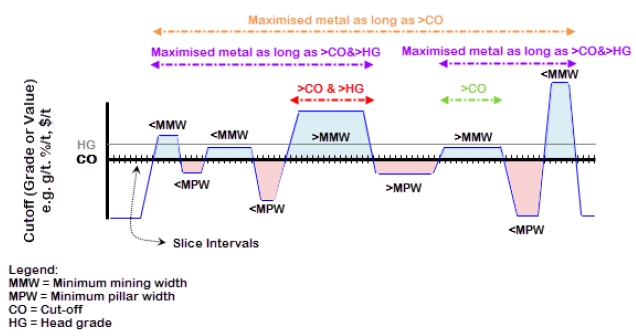
Intervals above (blue) and below (red) cut-off are identified, and the length of the interval relative to the minimum stope width (<MMW,>MMW) and the minimum pillar width (MMPW,>MPW) are identified. The area contributions above the cut-off (blue) have a positive contribution and the areas below the cut-off (red) have a negative contribution, with the goal to have a net positive area outcome.
A head-grade is specified in addition to a cut-off grade. Four different outcomes are possible for this data set:
-
Interval greater than cut-off grade
Includes both ">CO", and ">CO & >HG"
-
Interval greater than cut-off and head-grade
Only ">CO & >HG"
-
Interval greater than cut-off grade with optimise total value or total metal option
Includes both "Maximised metal as long as >CO" and "Maximised metal as long as >CO & >HG"
-
Interval greater than cut-off grade and head-grade with optimise total value or total metal option
Only "Maximised metal as long as >CO & >HG"
Both cut-off and head-grade numbers can be supplied as:
-
A fixed number (either as a grade per mass unit e.g. gm/t, or currency value per mass unit e.g. $/t) - using the discrete economics settings.
-
A calculated relationship between the value and some other variable related to the stope dimension, specified as points on a curve.
-
Stope Tonnage
-
Stope Thickness
-
Stope Height
-
Cross-sectional Area
-
Roof Hydraulic Radius
-
Wall Hydraulic Radius
-
Cross-section Hydraulic Radius
-
-
Values from the block model so that the value has a spatial property. For example, to vary cut-off with depth (with a default value applied if the field value for a given cell is ‘absent’ or if cells are absent from the model).
Summary
This part of the MSO workflow is used to:
-
Choose the objective (maximize grade or value).
-
Define cut-off strategy (fixed, from block model, curve table).
-
Apply optional head grade filtering.
