
What is Mineable Shape Optimizer?
To access MSO:
-
You can access MSO using the Report ribbon.
Mineable Shape Optimizer (MSO) is used to generate the optimal size, shape and location of stopes for underground mine design using an input of block model grades or values. It is particularly adept at generating detailed stope design to optimize the final location of stopes and pillars, allow for mining dilution, deal with narrow or dipping orebodies, and the maximization of recovered value.
Every orebody is different, and optimizing stope-shapes to those orebodies to produce realistic shapes is a complex geometric optimization problem.
MSO produces optimal stope-shapes, with careful selection of parameters, in a rapid and repeatable fashion. The procedure is not fully automatic and sensible selection of parameters and controls will assist to improve the quality of results for complex situations.
MSO - How it Works
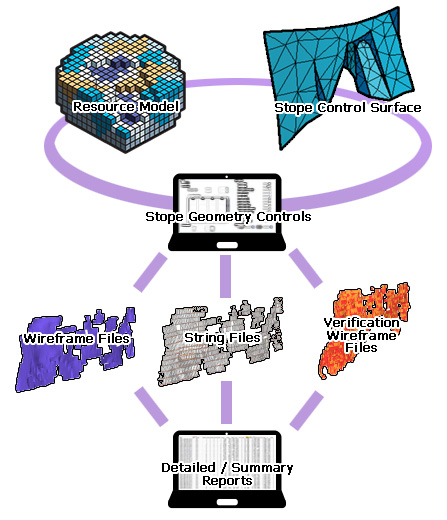
MSO mimics what an engineer would do, generating strings on sections, linking these to create a wireframe shape and then evaluating the wireframes against a block model. MSO provides a stope-shape that maximizes recovered resource value above a cut-off while also catering for practical mining parameters such as; minimum and maximum mining width, anticipated wall dilutions, minimum and maximum wall angles, minimum separation distances between parallel and sub-parallel stopes, minimum and maximum stope heights and widths, and so on.
The Shape Optimizer searches for the optimal mineable shapes taking into account the orebody geometry. The stope shape is parameterized, and mimics what an engineer might do generating outlines on adjacent sections, and linking these to create a wireframe shape for evaluation against the block model. The sectional outlines are defined by four points on the roof and floor. Constraints can be applied on the dip and strike of the final stope shape. Multiple stopes can be generated on a level section with minimum pillar dimensions enforced.
Stope Optimization Methods
MSO supports the following shape frameworks:
-
"Slice Method" generates and evaluates thin slices across the mineralized zones that are aggregated into seed-shapes (looking at all possible permutations) that satisfy stope and pillar width constraints.
The seed-shapes are then annealed to the final optimized stope-shape satisfying the stope and pillar width, stope geometry constraints (such as wall dips angles, strike twist, and so on), and other miscellaneous constraints (for example, zone mixing, exclusion zones, and so on). The result is a set of stope-shapes constrained to the basic limitations of the envisaged mining method.
- "Prism Method" which optimally combines a set of shapes from a library of stope-volumes within regions without allowing overlapping of the generated stopes. It is typically applicable to massive orebodies or wide/thick deposits whose stopes tend to be designed by blocking out the orebody in a grid-like pattern.
- "Boundary Surface Method" for narrow high grade reefs or lenses, where subcell modelling has some spatial accuracy limitations, it can prove more effective to model stope shapes off the geological wireframes directly. The stope walls are modelled as a mesh of points from [3x3] to [6x6] points. Dilution, orebody positioning in the stope, and an option to split the stope into waste and ore components, are provided.
See MSO Shape Frameworks.
Regardless of the method used for optimization, the input block model must have a VALUE field, or a GRADE and DENSITY field for optimization, and can also be a standard rotated block model. If the model cells do not fill the model space, as defined in the model prototype, or some grade fields are not defined, then the default grade, density or value field values are assumed.
The level spacing and section spacing for stope evaluation is defined by the defined shape framework. The shape framework prototype is assumed to have a single cell in the transverse direction, to allow the internal stope annealing process to locate stopes and pillars in the transverse direction.
Four configurations are possible for the block model, and shape framework definition:
-
Neither the input block model or the framework are rotated.
-
Both input block model and framework are rotated, and have identical rotation definitions.
-
Both input block model and framework are rotated, and have identical rotation definitions, but have a different origin.
-
One or both are rotated but do not have compatible rotation definitions. This case introduces additional complexity in the stope evaluation calculations and is significantly slower. A block model PLANE definition must be supplied to control the direction of model discretization. For the other three cases the model PLANE and the prototype PLANE are identical, and only the prototype plane definition is required.
For rotated models the PLANE is parallel to one of the model axes.
Three methods are provided for determining the optimal stopes, depending on whether just a grade value is available; a value can be calculated from the grade taking into account price, mining and processing costs and so on; or if the user can supply a calculated value estimate for the blocks in the model. A cutoff grade or value must be supplied.
Multiple passes through the model are used to identify stopes and sub-stopes (also referred to as stoping units and stoping sub-units), and development in economic ore. First the wireframes for the stope geometry are defined for full sized stope shapes; with the sublevel and section spacing defined from the stope shape framework, using the defined stope and pillar width parameters.
Sub-stopes can then be defined to identify ore that would satisfy a portion of the full height, or portion of the full strike after the ore in full stopes is removed from consideration, in the simplest case generating half or quarter stopes. A further pass can be completed to identify economic ore on the levels outside the stopes that could be mined during development.
MSO & Rotated Models
If the block model is supplied as a rotated block model, then the
stope optimization is carried out within the local coordinate system
of the rotated block model. The stope wireframe and strings
are transformed into the world (rather than being output in the local)
coordinate system.
Shape Annealing
In a Slice framework, once the approximate size, location and shape of the stopes has been determined, the Shape Optimizer internally uses an annealing process to refine the stope shapes. The annealing process takes the ‘seed’ shapes and anneals the shape to the final stope shape.
The seed shapes are generated by an internal search procedure that creates slices aligned with the dip and strike of the orebody, that are subsequently merged taking into account the lateral stope and pillar dimensions. The dip and strike values can be supplied as an average parameter, be calculated from a geology structure wireframe, or be supplied as a field in the block model to define the local orientation (for example, as evaluated with the Dynamic Anisotropy modelling option).
In a Prism framework, annealing does occur, but it is local and constrained, and applies only to specific parts of the stope geometry rather than to the whole shape.
Here's a comparison of how shape annealing occurs in each framework:
| Aspect | Slice Framework | Prism Framework |
|---|---|---|
| Primary optimisation method | Shape growth from seed slices | Selection of predefined prism shapes |
| Role of annealing | Core optimisation mechanism | Secondary refinement step |
| What annealing affects | Entire stope shape | Local parts of the stope geometry |
| Shape freedom | High – stopes grow and evolve | Limited – shapes are largely fixed |
| Crown modification | Emerges from slice growth | Explicit crown side annealing |
| Concave / Convex controls | Not user-defined | User-controlled via distances |
| Trough geometry | Not applicable | Optional shape variant |
| Dilution control | Indirect (growth + acceptance) | Direct (geometry + limits) |
| User control granularity | Broad behavioural control | Fine, local geometric control |
| Typical use case | Exploratory or flexible designs | Controlled, rule-based designs |
Post Processing
After optimisation, MSO provides a set of post-processing functions that allow generated stopes to be refined, adjusted, or reorganised before they are accepted as mineable designs. These functions do not alter the optimisation process itself; instead, they improve constructability, usability, and design coherence by modifying the resulting stope geometry.
-
Stope Splitting and Smoothing are available for both Slice and Prism frameworks. Splitting is used to divide large or irregular stopes into smaller, more manageable units that better align with mining sequences, sub-level layouts, or operational constraints. Smoothing removes sharp edges, small geometric artefacts, and irregular surfaces introduced during optimisation, producing cleaner stope shapes that are easier to interpret, validate, and mine.
-
Mid-Section Annealing applies primarily to the Slice framework, where stopes are grown through annealing from seed slices. This function allows targeted refinement of the central portion of a stope to remove local bulges, narrow waists, or unrealistic geometry while preserving the overall stope extent and economic intent. In Prism frameworks, where shapes are largely predefined, mid-section annealing is typically limited or not applicable.
-
Stope Merging and Stope Cutting apply to all frameworks, as they operate on the final stope geometry rather than the optimisation method. Merging combines adjacent or overlapping stopes into a single design where continuity and mining logic justify it, reducing fragmentation and simplifying mine layouts. Cutting performs the opposite role, trimming or separating stopes along logical boundaries to improve access, sequencing, or compliance with mine design rules.
Together, these post-processing tools help bridge the gap between optimised shapes and practical mine designs, allowing results from different optimisation frameworks to be adapted into forms that better reflect operational reality and planning intent.
See What is Mineable Shape Optimizer?.
MSO Outputs
The process outputs the wireframes for each stope, the section strings used to generate the stope shape (in plan, section or both), and a report table of insitu tonnes and other selected reporting fields.
Nominated grade fields can be reported on for the stopes. Other
fields can be nominated for evaluation as dominant fields; the
field value with the greatest tonnage contribution is reported for
characteristics like resource category, geological domain and ore
types where a weighted average is not appropriate.
