
Dynamic Modelling Outputs
Dynamic modelling uses input drillhole data to perform implicit modelling, block modelling and geological domain modelling, with optional fault block modelling.
The output data from the Dynamic Modelling workflow can be any of the following:
-
Combined solid – A single, combined wireframe representing geological domains, as described by the current domain task. We call this the "combined solid". See Configure Categorical Domain Task.
Data type: Wireframe object, multiple attributes with domain keyfields.
-
Separated domain solids – Independent solids representing each isolated structural domain or grade shell. These are known as the "separated solids". See View Separate Solids and Fault Blocks.
Data type: One or more wireframe objects, each representing a single geological domain. See
-
Geological model – A block model, generated around a defined prototype, using the combined solid to create domain-specific zones. See Create a Block Model.
Data type: An unrotated or rotated block model, with or without subcells plus domain-specific zones, ready for grade estimation.
-
Fault sheet data – Fault wireframes used to delineate fractured geology, emulating shear zones. See Model Faults.
Data type: Wireframe object containing one or more open surfaces supported by a fault identification attribute.
-
Separated fault blocks – Independent solids representing each generated fault block. These are also "separated solids". See Model Faults and View Separate Solids and Fault Blocks.
Data type: One or more wireframe objects, each representing a single fault block.
-
Post-processed custom data – Bespoke outputs from macro automation, potentially using inputs from the Dynamic Modelling workflow. See Integrate Modelling Macros.
Data type: Any
-
Settings file – An XML file used to store your modelling settings. This is typically stored in your project folder or project archive.
Data type: XML file.
Most output data is directly manageable after creation, using proprietary visualization and editing tools (although note that edits made outside the Dynamic Modelling workflow will be overwritten the next time the same outputs are generated).
Combined & Separated Solids
Wireframe solid data, as you can see above, is created as both a unified (combined) data object representing domains or fault blocks, supported by domain key fields for filtering and evaluation, but also as "separated solids"; independent data objects representing a particular domain or fault block.
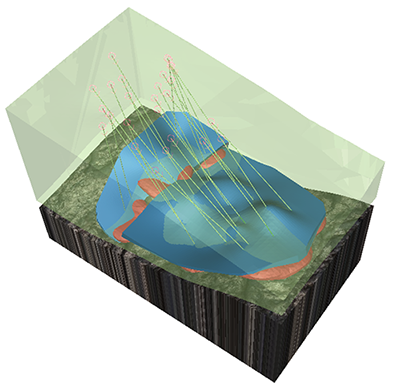
Geological modelling with independently formatted separated solids
See View Separate Solids and Fault Blocks.
