
generate-outlines ("ou")
See this command in the command table.
To access this command:
-
Digitize ribbon >> Create >> Outlines.
-
Digitize ribbon >> Create >> Outlines >> Generate outlines without attributes.
-
Draw (Features) ribbon >> Outlines >> Generate.
-
Draw (Profiles) ribbon >> Outlines >> Generate.
-
Using the command line, enter "generate-outlines" and press ENTER.
-
Use the quick key combination "ou".
-
Display the Find Command screen, locate
generate-outlinesand click Run.
Command Overview
Generate outlines (perimeters) from areas defined by multiple crossing strings.
The strings used to create outlines must lie completely within the current clipping limits. A string will not be used if any point on that string is outside the clipping limits. If there is a current string filter this is applied. Only currently displayed strings are used to generate the outlines.
The resultant outlines (strings) have LSTYLE set to '1001', SYMBOL set to '201 and COLOUR set to '1''.
When you run this command, a dialog opens so you can choose how outlines are generated and where outputs are stored.
Once generated, outlines can be checked with query-string to calculate and display the total length and area of individually selected outlines in the Output window.
Command steps:
-
Display the required strings object in the data window.
-
Run the Command.
-
On the Generate Outlines screen, select the Method:
-
All possible outlines to generate all closed perimeters found in the displayed data.
-
Individually selected only to generate one outline at a time from the area you select.
-
-
Select whether to Constrain Creation by Matching Attribute. If selected, select the attribute to use.
-
In Output, select a loaded strings Object or enter a new output object name.
Note: Leaving this field blank automatically creates a new strings object called "New Outlines".
-
Click OK.
-
If you selected Individually selected only, in any 3D window select (left-click) inside each enclosed area where you want to generate an outline.
-
Follow the status bar prompts to complete the command.
-
Click Done to exit the command.
Outline Generation Examples
Example: Individually selected only with new output object
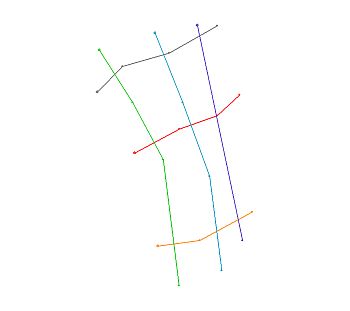
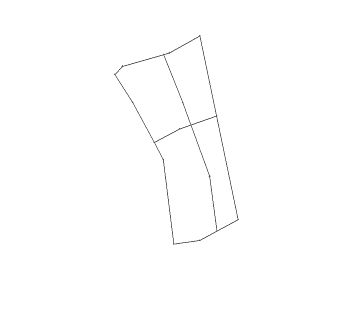
In the following example, a set of crossing strings is used to generate outlines by individually selecting enclosed areas; the resultant outlines are stored in a new output object.
The original set of crossing strings:
The resultant outlines stored in the new strings object:
Example: All possible outlines with existing output object
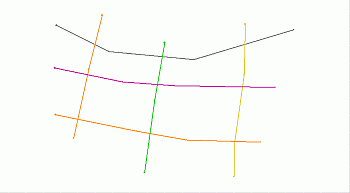
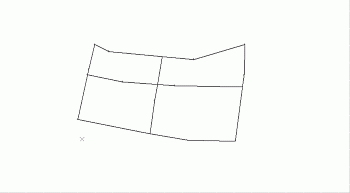
In the following example, a set of crossing strings is used to generate a set of all possible outlines.
The original set of crossing strings:
The resultant outlines were generated without selecting any crossing strings and replaced the original strings in the strings object:
Related topics and activities
