
Appendix—The Different Types of QC Samples
Overview
QC samples are inserted into the analytical stream and analysed along with samples from a client so that assurance is given to the laboratory that the results reported to the client are correct.
When performing testing on client’s samples, even given the most stringent laboratory processes, there is a chance that the results are wrong. For the laboratory to have confidence that the client samples are accurately tested and reported, the laboratory also analyses other internal samples for which the expected results are known, in conjunction with the client’s samples.
These internal samples are called quality assurance or quality control samples. These samples are processed in the same manner as the client’s samples so that if there are any systematic errors present, they is applied to the QC samples along with the client’s samples.
Basically if these quality control samples do not return the correct results, the laboratory has less confidence in the results for the client’s samples, and might need to repeat the tests to ensure that the results reported to the client are the best that the laboratory can generate.
QC checking can also include the checks for the natural range of results that can be suitable for a particular test, to ensure that the test method is suitable for that overly large or small result.
Part of the quality assurance checking can be the assessment of the results (for the client’s samples) against the specifications that are applied to the sample. If the QC samples all pass, but the specifications fail, then different procedural actions might need to be applied.
Different Types of Samples in CCLAS 6
Different types of QC samples are added to a job to allow the system to perform precision and/or standard QC assessments, allow the Quality Assurance (QA) Manager to determine the quality of the results.
The following types of samples are available in CCLAS.
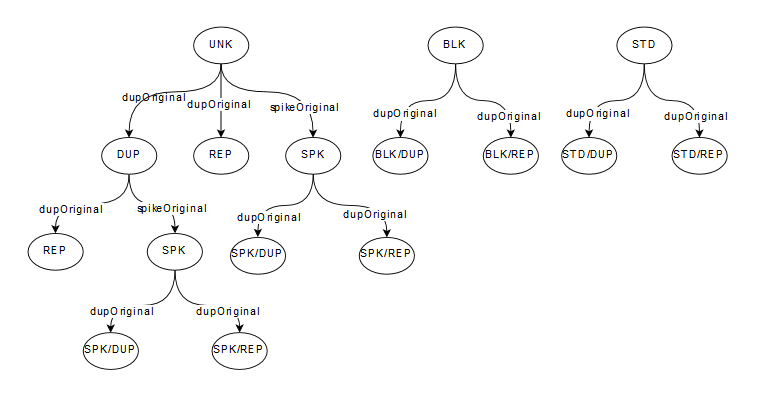
The following diagram shows the relationships between QC sample duplicate and replicate splits and the original sample.
Precision Assessment
Precision assessment is where the results for two samples are compared against expected limits, where the samples are splits of the same parent sample.
Duplicate QC Samples
Sample splitting occurs very early in the sample preparation or sample handling processes, after which, the subsequent precision analysis provides a view into the consistency of sample preparation. The split sample is known as a duplicate sample of the parent sample.
Once the samples are split (presumably into exact copies of each other), then as they are tested in the lab for all the same tests, they are treated as separate samples, and might be analysed:
- In different batches/groups
- On different instruments, or
- By different operators.
The end results should be very much the same, thereby giving the lab confidence that all the variations to the testing processes haven’t contributed to their results in any significant way.
Duplicates are also taken to check the consistency of the original materials as they are presented, as there is the assumption that the original sample is fairly homogeneous in nature, so it should matter which half (or portion) is being tested. If there is a chance that the sample is NOT homogeneous, then the sample needs to be prepared and mixed thoroughly so that each segment should have the same probability to generate the same result.
Duplicates are used to highlight QC errors such as swapped positions, contamination in preparation, precision.
A scheme version analyte holds the limits used for precision assessment of duplicate samples.
Replicate QC Samples
Replicates are similar to duplicates, except taken at a much later stage in the analytical processing, after which, the subsequent precision analysis provides a view into the consistency of analytical preparation. The split sample is known as a replicate sample of the parent sample. A replicates might be taken for a specific test and not all tests.
Replicate samples are analysed in the same batch or rack, by the same operator and instrument. These replicates give the laboratory a measure of the spread of the results, and can also be used to detect any swapping of samples during the analysis process.
Some tests require that all the samples are analysed twice, in which case not only are the pairs of results compared, they may be averaged for the client, thereby giving them more confidence in the results.
Replicates are used to highlight QC errors such as swapped positions, contamination in analysis, precision.
A scheme version analyte holds the limits used for precision assessment of replicate samples.
Standard (Accuracy) Assessment
Standard assessment is where the results for a sample is compared against expected limits of a control material known as a blank or standard.
Blank QC Samples
Blank samples are created from either industry materials, in-house materials, or client-originated materials, where the material contains non-detectable amounts of specific analytes. These are used to detect background interference in the analytical process. Typically blanks can be purely made up of the same reagents used in the testing processes, to make sure that there is no contamination of the ingredients or reagents used in the test.
Blanks usually have a zero target value for the 'active' analytes, but there is a typical range that the test allows results to be within. Blank samples are added early in the sample preparation processes (for example, the crushing or grinding stages) to ensure that the equipment is sufficiently cleaned between samples.
For example, if beach sand was treated as a blank for gold, the chances of any gold being present is very low, so it could be a simple and cheap way to run a blank through the test. If any gold was detected in the blank, then the reason is identified: samples are mixed up, or contamination has occurred in the testing or preparation processes. So, clearly, a beach sample would be a hopeless blank where silica or silicon is its main component for assessment.
blank QC samples are used to highlight QC errors such as swapped positions, contamination and accuracy.
Standard QC Samples
Standard samples are created from either industry materials, in-house materials, or client-originated materials, where the material contains known amounts of specific analytes. Not only is the expected value of the analyte known, its typical allowable range of the results is also known and recorded in CCLAS. Standard samples are used to satisfy that the analytical process is performing as expected over a range of results.
Industry standard materials (also called reference materials or certified reference materials), are expensive and available from different suppliers around the world, tested and certified by multiple laboratories. Internal or in-house standards are manufactured and certified by the laboratory. In-house standards are often cheaper to produce, and tailored to suit the exact types of samples that clients may submit. Client standards are samples identified as control substances when they are registered as an unknown sample in the laboratory.
Standards QC samples are used to highlight QC errors such as swapped positions, contamination, accuracy.
Spike QC Samples
Spike samples are special QC samples as it involves taking another portion of the client’s sample (that is being tested in the group), or a duplicate of a client's sample, and adding a known amount of a reagent or standard to it.
When the results are compared, because the client sample gets a result, the spike gets a result, and because the system knows how much of the analyte was added (spiked), it can mathematically compare these two results to have confidence that the test process is accurate.
Spikes are used to highlight QC errors such as swapped positions, contamination, accuracy and matrix impacts.
Process
Creation and Maintenance of QC Samples
QC types are created and maintained using the CCQCTP—QC Type application, which is also accessed using the Analysis Setup » QC Types menu option. Refer to the Maintaining QC Types and Assessments process.
Dependencies and Restrictions of QC Sample Creation
QC samples are created at job registration, typically using a QC mask to define the insertion of the QC samples into the samples registered for a scheme in a job.
QC samples are created only for schemes with Scheme Type of Analytical and Analytical Prep, and cannot be shared across scheme versions.
 Related processes...
- Creating QC Samples using QC Masks
- Maintaining Batch Samples
- Maintaining QC Types and Assessments
- Assessing Results against Detection Limits
- Assessing Results against Scheme or Surrogate Limits
- Assessing Results against Accuracy Limits
- Assessing Results against Precision Limits
- Assessing Results against Product and Specification Limits
