
Haul Routes: Bench Exits
To access this screen:
-
Using the Scheduling Setup screen, select the Haul Routes icon on the left, then select the Bench Exits tab.
Use the Bench Exits tab to add and delete bench exit nodes, and to select and save node objects. This is part of the settings used to define haul routes.
At least one Bench Exit point should be defined by its Node ID for every bench that is to be scheduled. It is possible to have multiple Bench Exits on a bench and your application will select the nearest Bench Exit considering:
-
The Bench Exit with the shortest distance (allowing for Bench Haul Factor) is selected if it is within a specified vertical tolerance (default is 5m) of the toe of the Block being mined.
-
If there are no exits within the vertical search tolerance then the search is expanded increasing the vertical tolerance until an exit is found. The additional ramp haulage to get to this Bench Exit is included in the cycle time.
Bench Exists and Pushbacks
At least one bench exit point should be defined by its Node ID for every bench that is to be scheduled. It is possible to have multiple Bench Exits on a bench.:
The bench exit with the shortest distance (allowing for Bench Haul Factor) is selected if it is within a specified vertical tolerance (default is 5m) of the toe of the Block being mined.
If there are no exits within the vertical tolerance then the search is expanded increasing the vertical tolerance until a bench exit is found. The additional ramp haulage to get to this bench exit is included in the cycle time.
The bench exit is only valid if the pushback number for the Block being scheduled matches the pushback number in the Bench Exits table. This allows for the fact that bench exits are mined out as the pit expands and Bench Exits will only become available when a pushback commences.
If a bench exit is to be used by blocks that belong to a number of pushbacks then the bench exit is repeated for each pushback.
Add or Select Bench Exits
To add a new bench exit using a vertical search tolerance:
-
Display the Bench Exits screen.
-
To add a bench exit node, click Add on the Bench Exits tab.
-
In the Pit Exits, define the required parameters.
-
Define Node ID and (if used) Pushback.
-
Enter the location using X Coord, Y Coord, and Z Coord, or read the location from a Datamine object loaded in the 3D window.
-
- Define at least one Bench Exit point (by Node ID) for every bench you schedule.
If you have multiple bench exits on a bench, your application selects the nearest bench exit as follows.
-
The bench exit with the shortest distance (allowing for bench haul factor) is selected if it is within the Vertical Search Tolerance (default is 5 m) of the toe of the block being mined.
-
If there are no exits within the vertical search tolerance, the search expands until an exit is found. The additional ramp haulage to reach that bench exit is included in the cycle time.
Note: The location of the Bench Exit can be entered in terms of its X, Y and Z co-ordinates or it can be read from a Datamine object that has been loaded into the 3D window (see below).
To select an existing bench exit:
-
Display the Bench Exits screen.
-
To use an existing node points file, click Select Object.
-
On the Select Object screen, select the required node points file.
For more information about node point files, see Select Object.
-
To configure the vertical search behaviour, set Vertical Search Tolerance to the search radius value (m) used when mining blocks are assigned to a bench exit.
The vertical search tolerance controls the search distance in the Z direction, relative to the toe of the bench, for the nearest bench exit for the selected block.
Using a Vertical Search Tolerance
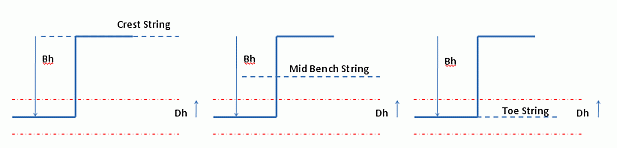
The Vertical search tolerance, for the String Position options shown on the Select Data screen, using a default bench height, can be illustrated as follows:
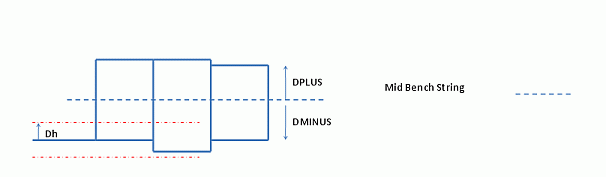
Using a variable bench height (DPLUS and DMINUS option) can be illustrated as follows:
-
If a Default bench height is specified then the String Position must also be specified.
-
If DPLUS and DMINUS are to be used then the String Position does not need to be specified.
-
If DPLUS and DMINUS are to be used then the string object must have these columns and they must not contain absent values.
-
Alternatively, if DPLUS and DMINUS are present in the Block Reserves they can be copied to the string object by selecting Add block attribute on the Field Treatments screen.
-
-
Click Save to save the nodes.
Note: To delete a bench exit, select the bench exit, then click Delete.
Related topics and activities
